|
Order this issue (print)
Preface
View PDF
Shireen Hassim
The Gender Pact and Democratic Consolidation: Institutionalizing
Gender Equality in the South African State
Order this article (pdf)
Smitha Radhakrishnan
"African Dream": The Imaginary of Nation, Race, and
Gender in South African Intercultural Dance
Order this article (pdf)
Roshila Nair
drought; Heritage Day (24/09/00) (Poetry)
Order this article (pdf)
Gay W. Seidman
Institutional Dilemmas: Representation versus Mobilization in
the South African Gender Commission
Order this article (pdf)
Malika Ndlovu
born in africa but; Lydia in the Wind (Poetry)
Order this article (pdf)
Thenjiwe Mtintso
Representivity: False Sisterhood or Universal Women's Interests?
The South African Experience
Order this article (pdf)
Barbara Boswell
WEAVEing Identities
Order this article (pdf)
Diana Ferrus
Tribute to Sara Baartman (written in Holland, June 1998); The neverending story -- 1810-2002 (Poetry)
Order this article (pdf)
Catherine Albertyn
Contesting Democracy: HIV/AIDS and the Achievement of Gender
Equality in South Africa
Order this article (pdf)
Roshila Nair
an unforgiving poem; aluta continua (Poetry)
Order this article (pdf)
Kimberly Miller
The Philani Printing Project: Women's Art and Activism in Crossroads, South Africa
Order this article (pdf)
Gabeba Baderoon
Cinnamon; Play, or, Watching a Film about Muslim Boys; Contemporary Architecture (Poetry)
Order this article (pdf)
Taghmeda Achmat, Theresa Raizenberg, Rachel Holmes
Midi and Theresa: Lesbian Activism in South Africa
Order this article (pdf)
Natasha Erlank
Gender and Masculinity in South African Nationalist Discourse,
1912-1950
Order this article (pdf)
News and Views
Order this article (pdf)
Notes on Contributors
View PDF
Publications Received
View PDF
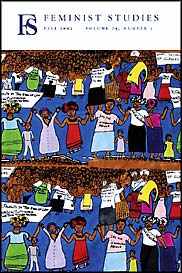
Cover Art
The Philani Printing Project
Umanyano Ngamandla (Unity Is Power), 2000. Acrylic on cotton,
56 x 72 inches.
© The Philani Printing Project.
Photograph by Kurt Gohde.
|
-Corner.gif)