
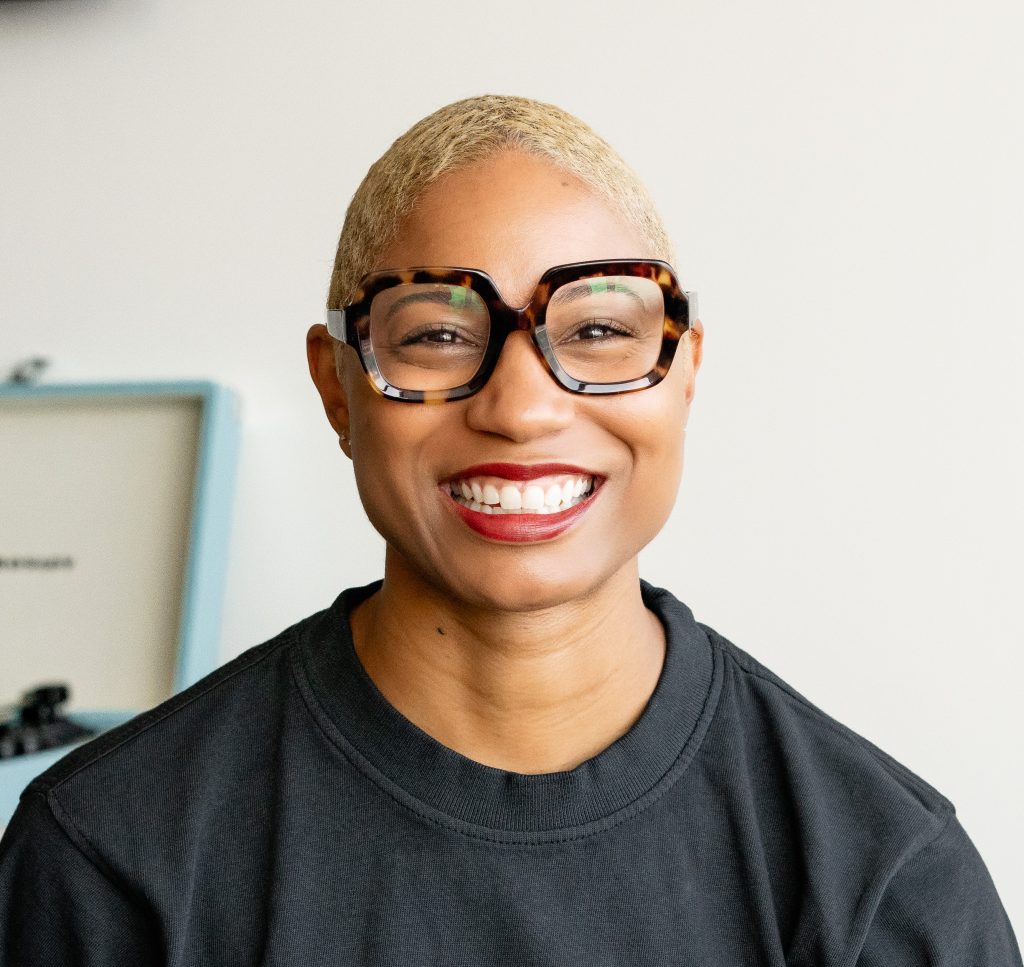
Jennifer (JN): It is my honor to be in conversation with Courtney M. Cox, the author of Double Crossover: Gender, Media and Politics in Global Basketball (University of Illinois Press, 2025). In addition to being an esteemed author, Cox is associate professor of Indigenous, Race, and Ethnic Studies at the University of Oregon.
I want to start by asking you to think a bit about two things that are happening at the same time. One is the increased visibility and popularity of the WNBA. I’m particularly thinking about the expansion teams in Golden State, Toronto, and Portland, and soon Cleveland, Detroit, and Philadelphia. I have seen all the data from the WNBA’s opening games about record setting sold-out arenas. And then we have a kind of preoccupation on the Right with women’s sports, and policing women’s sports, here we can think about Trump’s preoccupation with — in his words — keeping men out of women’s sports. I wanted to ask you to think with us about these two things happening side by side: The popularity of a league that was made famous by the labor of Black women, particularly Black queer women, alongside the Right’s preoccupation with trans athletes.
Courtney (CC): Maybe I can bring it all together: very anecdotally, I have seen how folks within athletics departments in college programs struggle with federal policies which are very different than a professional league that gets to run the way it wants to. There’s very trans-inclusive policy at the WNBA level, for example.
The IOC (International Olympic Committee), FIFA (International Federation of Association Football) and FIBA (International Basketball Federation) are global bodies that govern bodies in particular ways. The NCAA is operating both as a governing body and is bound to federal policies.
In my book, when I was covering the 2023 National Championship (which was infamous for a variety of reasons, with Iowa and LSU’s matchup), it was also the culmination of a yearlong celebration of the 50th anniversary of Title IX.
There were all these activities happening in Dallas where the Final Four was being held, where everyone’s celebrating Title IX, saying, “We made it, we’re here.” Part of the way that that’s being quantified is about the sellout crowds. It’s about the numbers of millions of folks that are watching games on ESPN. There are these markers of growth where people are saying, “The game is growing, people are going to follow these college players to the WNBA.”
At the same time, when I’m standing in Dallas, there’s a roving truck, the kind of trucks that have the big ads on them. It has this anti-trans policy on it and its circulating around this space that’s supposed to be celebrating women’s sports and this Title IX moment of gender equity across educational spaces. There’s this weird juxtaposition of the numbers saying one thing, but we’re always having these reminders, right?
For every moment of progress — You know, I start my book in 2020 so we can think about what we were talking about in that year, and all the things that have come full circle. I think growing pains is how I’ve been sitting with this moment: if you’ve been a longtime fan of the W, or of women’s college basketball at any level, you’re thinking, “Wow, it’s way more expensive to renew my season tickets.” “League pass is more expensive.” “I’m finding all of these folks that are invading this space that in many ways kind of felt sacred.” There’s that growing pain for the fans who have been here. It’s more eyes on the league. There’s also more folks that are holding the league accountable, new folks coming in who have big questions that we’ve asked for a long time.
I am cautiously optimistic when it comes to certain things. The new CBA is one of those things that we’ll be studying for a long time. But then there’s always the very predictable response and backlash anytime there’s that heightened visibility that we see.
JN: That’s really interesting. I love the growing pains concept. It’s a really useful way of thinking about it. I wanted to ask you a question that maybe builds on that, that’s kind of about the frameworks that operate for understanding this moment.
I was teaching a gender in sports class, and one of the things my students loved was stories about romance and the W. I kept saying to them, “It’s really interesting that we have these two predominant narratives for thinking about women’s basketball. One is rivalry.” And of course, you have in your book reproduce the famous picture of Caitlin Clark and Angel Reese, right? As I tell my students, rivalry in sports is so often racialized. And then there’s romance, with everyone saying Paige [Bueckers] and Azzi [Fudd] on the same team: what does that mean? I’m really interested in these two frames we have for reading athletic women’s bodies and what they- what these narratives permit and also what they foreclose.
CC: I think it’s so funny because there are certain things that happen in the W that could only happen in the W. I think there are folks that latch onto that, including folks that now call the NBA, the MNBA- that I think is really fun. And they’re like, “You can never get this drama. You can never get these storylines elsewhere.” So the rivalry and romance: I think the most vivid version is this kind of iconic moment in this very heated battle between Diana Taurasi and Seimone Augustus where they kiss. (laughs) And it’s kind of so silly it diffuses the situation. It’s not per se romantic, it’s a romantic gesture, but it’s done in the heat of- like, rivalry.
I think there are very few other leagues, I think about other sports just because of the equipment, like hockey wouldn’t have the same kind of moment … when you’re about to fight, you know? But I think people really struggle. Paige and Azzi are one particular case study. The media that is newer to this league is struggling with this idea of how Paige and Azzi are going to handle the team dynamics.
And I’m like, “Have you looked at any women’s college basketball roster? Anywhere, at any time, any high school roster? Like, this is a tale is old as time.” I think when people are feeling like a Heated Rivalry spin on basketball, I’m like, “These are the OGs of this.”
The ways that these players have had to navigate rivalry, whether it’s we were rivals in college and now we’re on the same team. Or we’re on the same team now, but we’ll be playing against each other overseas, um, or we fell in love, and we’re exes and it’s really hateful and it builds for a really good rivalry later.
I think that there are those storylines. What I struggle with is the lack of care that we’ve seen in terms of folks being able to follow the dynamic. There’s been a recent controversy with a publication publishing something about two folks that are no longer together. (laughs)
If they followed any of these things online, they would know that there’s a lot of drama outside of it. I think the struggle is that there’s all this richness, there’s all this goodness. It’s never operating from a place of scarcity, but what I see is that the media hasn’t caught up. And I say media very broadly. There are folks that have been doing this work for a long time and following this league, both in terms of investigative stuff, like when big things happen, Dearica Hamby’s lawsuit with the WNBA is one example.
We now have the kind of the Dearica Hamby clause in the new CBA to really make sure that folks that are parenting are not treated unfairly or discriminated against. I wish there was more journalism to cover that, to cover when teams are behaving badly, when players are treated poorly. I also wish the fun, playfulness, the shade room of it all, got its full due as well with people that were really tapped in. Because the fans are tapped in, the folks that have been running blogs for years are tapped in, but mainstream media is still catching up. So that’s my other side of growing pains.
JN: As you were talking, I wanted to think more about motherhood. I was remembering a moment that always struck me, which was when Adia Barnes was coaching in Arizona and she would pump breast milk at halftime. I always thought, “Oh, there’s much more to be said about that moment.” So I wanted to ask you to talk a little bit about, um, how you see the identity of W players as athletes and some players’ identities as mothers intersecting. Like, how do we understand the mother, athlete? Um, what does that role look like? How is it negotiated or how is it maneuvered to use some of the terms from your book?
CC: So, you know, there’s the more vintage renderings where we always need these athletes to be tethered to a man or their own kind of maternal instinct where that’s just the classic playbook of “Oh, look, Candace Parker, she’s going to come a mother.” You know, like the ways that we’ve seen that historically shaping the narrative of women athletes across the board, not just in the W and in college sport. But I think the thing that’s interesting to me is that the actual protections, the labor protections that go along, and the actual grind of that, like pumping at halftime, the ways that arenas are not always accommodating in terms of that. We don’t necessarily have lactation rooms in every arena, for example. I think accessibility has always been the undercurrent, even though there’s this hyper visibility. They can’t wait to tell us that an Olympian is a mother. They are like, “Yes, she’s married to a man … and she had a kid.”
Even the coverage of queer women who are mothers, even the coverages of queer folks in general has been really struggling to catch up. The other thing I want to think about is the relationship of the body and labor. What I’ve been learning a lot from athletes, um, Imani McGee-Stafford, um, is both playing internationally, she played in the W as well, and she represents the Puerto Rico national team and will be playing in the FIBA World Cup this fall. She was talking about what it means to think about when to become a mother. She’s in her 30s. And she’s like, “I’m constantly traveling around the world. Healthcare is changing depending on where I’m playing. Do I want to freeze my eggs? When am I going to have time to be in one place to sit down to have these kids that I want to have?” She’s part of these questions that a lot of folks are thinking about.
What I’ve been thinking about is how athletes have to be very cognizant about these cycles and seasons of life. I’ve been thinking about the desire to become a mother, a desire to parent, as also something athletes have to navigate.
JN: That is really interesting because as you were talking, I was thinking about motherhood as a kind of marketable strategy and motherhood as a liability. I do also follow the MNBA, though not as closely as the W. And one of the things that strikes me about both the NBA and the W is how more and more, you will see athletes holding up their kids during interviews. Just a few days ago, Joel Embiid had his son in his arms during an interview and his son said, “Daddy, I lost a tooth.” And it was this lovely moment. Or I think all the times Napheesa Collier’s daughter is on court and I think, “Oh, look at her. She’s cute.” And so there’s this way in which the cute babies help athletes build a certain kind of brand. But I think you’re also helping us think about how for female athletes in particular, with this question of timing, there’s a way in which motherhood can become a liability.
Speaking about marketability, perhaps the topic that everybody thinks about when they think about sports these days is NIL. I wanted to ask you to talk to us a bit about how you’re thinking about the landscape of race, gender, and NIL. I was noting a moment in your own book where you say “Female athletes in general are less likely to be chosen to endorse a product. And when they are chosen, 81% are either in suggestive poses or scantily clad.”
CC: The NIL question is really interesting because when I was writing this book — and the book is from my dissertation which changed radically because I graduated in 2019. I thought I had a book that was about how folks move across borders and leagues. Then 2020 happens. I’m like, “The whole book is obsolete now. That’s not how we do any of this.”
But one of the things that I was really thinking about when I started at Oregon that year was the 2019–2020 season at the University of Oregon which was a very exciting time to be following women’s basketball. We have, my big three with Sabrina Ionescu, Ruthy Hebard and Satou Sabally. What I was really interested in at the time was Satou and her sister, Nyara, who are both from Germany, they’re from Berlin.
I had done this research about Black US players going to play overseas, but I hadn’t really thought about that reverse migration. I was like, “Oh, Sabally sisters, we’re doing this.” I was so into them. One of the things that I learned was that one of the reasons Oregon had so many international players that they could bring to Eugene was because they had someone, an assistant coach from Spain, and he was going and recruiting internationally and saying “… I play college ball in the States, you can do that too.” If folks aren’t familiar, for a lot of these players, they’re used to going pro at 15, 16 in Europe. So it’s kind of a big sell to be like, “Hey, do you want to go to another country and play for free?” That really isn’t part of the narrative for a lot of folks. Coach Lopez, who was going and recruiting these players spoke to me about the growth and expansive recruiting in the women’s game. We’re used to people having to get in cars and drive, not getting much flight allowance.
Now we’re talking about, if you look at the college rosters now, they are more international than ever. So obviously in 2020 we don’t get the March Madness of our dreams because of COVID-19. But what we do end up getting, when NIL really ramps up, is this question of what do we do with international players?
Part of what is complicated is the F1 visa and all of its parameters in this post-9/11, very xenophobic policymaking landscape. Students that are under these visas can’t make money outside of this kind of campus work that they’re doing. What we’re seeing is a new kind of inequality form for international athletes who are struggling between NCAA policies on NIL and federal policies as student visa holders. Of course they are even more scrutinized in this current moment, this current landscape, this current regime that we’re under. So one of the things I continue to look at is how universities’ international student assistance is really going to help close that gap.
The other piece that you mentioned is this idea of marketability, and who can sell, right? The big conversation was this idea of deficit of like, “Oh, the men will always make more money than the women.” But we’ve seen that, that isn’t necessarily the case. It’s so case specific where there are gymnasts that are making millions of dollars.
There are ways that this big lumpy category of Olympic sport, which basketball’s an Olympic sport, but it’s also read as a revenue generating sport sometimes too- it kind of operates in an interesting space. We saw early on, it does tend to be white heterosexual women who were benefiting upfront. But then I think there’s been a creativity. I think that’s where the crossover comes into play for me in how I think about how folks navigate. There are maybe more niche audiences or niche ways of thinking about marketing and promoting yourself, whether folks are really into some kind of style component, whether it’s hair or fashion, whether they’re thinking about these kind of smaller influencer opportunities. Or whether they’re making music, you know? I’m thinking about Flau’jae Johnson here, who signed to Roc Nation.
A lot of the things that might have held them back because of these policies the NCAA had and their parameters of what they thought amateurism should look like have been really opened because these are multifaceted folks that are like, “I can start an Etsy, but I can also get money from that local dealership, but I can also sell something at a larger kind of level.” I think there’s been new inroads that I didn’t expect in terms of who can be read as marketable.
I do think that the kind of relationship between race and gender performance is really important. I think about presentation in terms of both gender presentation as well as skin tone, as we see a lot more of the light-skinned girls get the opportunities. I’ve been trying to think about how some universities put way more money into NIL, and that’s how they recruit players too. I’m at one of those universities. You are too. (laughs)
JN: Yes, I am. (laughs)
CC: They can say, “You don’t even have to worry about it … we have found the places to plug you in.”
JN: I think the piece about international players is particularly interesting. Because I remember, watching the draft this year and realizing that many of the top players were from overseas. Something has fundamentally shifted. I come to know players because of my obsessive watching during March. But now I am seeing players get drafted in top picks who I have never seen play. I think there’s much more to be said about international players. Because I think for a long time that was a conversation about W players going overseas to make money because of the W’s poor payment structure.
I also wanted to ask you to talk a bit about the intersections between Black feminist studies and sports studies and to say a bit about what Black feminist studies brings to sport studies, and also to help us think about if there are spaces of friction between those two fields?
CC: I think one of the things that’s really interesting, as someone that studies sport but is in an ethnic studies department, people are always like, “Oh, aren’t they, isn’t there a conflict on a campus between the sports and the ethnic studies?” My job was marked as race and sport, and I was really drawn to that. I’m trained as a communication scholar. My background is as a former journalist within sports media. I was drawn to the idea that I wouldn’t have to explain myself which is often the case in spaces where you have to explain why you do sport. And then in sports spaces, you have to answer the question why are you focused on Black women?
I think at its best, sports studies really benefits from black feminist studies. There are a lot of folks that use the term intersectional in the work that I review. I see it in the journal articles all the time. But I see no citational practice, and it’s really not implemented. One of the things that causes tension, I think, is sometimes when I’m talking to other Black feminist scholars who study sport is that there will be a chapter of a book that’s supposedly about gender in sport or a certain time period, and there’s one chapter about Black women. “This is how Black women were in tennis or basketball or-” And so the analysis of that chapter, if it was spread out to the whole book, would change the landscape of the book if it wasn’t this silo. Or if whiteness wasn’t the default way we were studying gender in sport.
Part of my work emerged from, like, “Okay, I see this book says it’s about Black athletes, but there’s one chapter in the whole book about black women.” I feel like the tokenism that has been happening is something that many folks are working on. I’m seeing a new generation, even of graduate students who are doing some really interesting stuff. I’m really excited about the future of folks that say, “I want to study Black women in country club sports.” Or how Black women athletes are navigating sports like soccer. That’s a very different environment than what I’m studying, a sport that’s read as Black, like basketball. I’m really excited about that because they are actually grounding the work in Black feminist theory. I think that’s very different than this kind of add-Black-women-and-stir kind of thing that I think had been unfortunately very characteristic of folks studying race or gender in our field.
I think the other thing is there are folks that are doing interesting work thinking about queerness in sport. But I think the specificity of Black queer life has yet to be fully unpacked. And so, for example, I think about how there was was this general learning of the term stud via the Studbudz. Thinking about, like, white gay male WNBA fans who are asking me, “So, so tell me what a stud is. Why do they call themselves the stud buds?”
I think about the lexicon that happens in these spaces, and how it requires a Black queer reading to really be at its best. And so I think that’s the work we still need to do. I think that these athletes are theorizing about the worlds that they occupy. And so I think there’s a little more centering that I’d like to see done in terms of both the scholarship people are citing, as well as understanding that these are incredibly intelligent folks that have big ideas about how these things intersect. A lot of them read our stuff that I think is really exciting too, being in that conversation and community with each other.
JN: That’s amazing. You have this great moment in the introduction when you’re drawing on bell hooks and you write, “When Black women and non-binary athletes are centered in scholarship, there’s an overwhelming focus on how the double jeopardy or dual bind of racism and sexism affects their lives. In this book, I’m most concerned with moving forward and building upon this knowledge, delving into how they experience community, pleasure and agency within the sporting space.” And then you go on to say, “I continuously ask what it would mean to intentionally reside in the margins to see, create, and imagine possibility from these athletes’ current standpoint.” I love that moment because I see you thinking with scholars including bell hooks and Aimee Cox.
This question about what it means to be interested in Black women athletes, Black non-binary athletes, not to prop up the idea of marginalization or violence as constitutive of their experiences, but to think about the variety of ways that they maneuver in their workplaces, which is what the W is, their workplace, but also about the kinds of kinship, pleasure, fun, community, agency they experienced. I really appreciated that.
I wanted to ask you some quickie questions.
Dawn Staley and Geno Auriemma!
CC: Yeah.
JN: What do you think?
CC: You know, I’ve decided my new reference point is calling that man Luigi. I think he has lost his right to Geno. We’re going by government names now!
I was thinking about would it mean to actually take all of these folks that I’ve read, that I adore, like Aimee Meredith Cox, whose work is foundational to how I think about how participant observation works. This isn’t a Detroit shelter, but there’s ways that I want to think about choreography, as Cox is talking about from a dancer’s standpoint. We need to be learning from dancers and dance studies as well.
At the same time, when I think about that choreography of knowing what’s expected of you, knowing how you’re perceived, and knowing how you’re going to move, I see that so often. I think Coach Staley has mastered it in a way that is life-changing. I take notes: that’s how I’m going to move through faculty meetings, That’s how I’m moving through my email inbox. One of the things that I have found so important is her leadership is not only how I see her players adapt and move through space, but I also see it in different ways that Black women coaches move, which I think deserves its own chapter. Someone should definitely be studying Black women coaches, or the lack thereof, right? We have no Black women head coaches in the W this season, which is very telling to me.
The thing that I really have been struggling with is thinking about the University of Connecticut assistant and associate coaches, those Black women that have often hit a ceiling. You can look on any bench. There’s a lot of Black women, many of whom played the game, have coached for a long time, that don’t get those looks for head coaching opportunities. They have been ready. And so what I see is when he walks off and abandons his players who are losing their very first game that season-, you’re seeing them cry on the bench, some of them, it’s their very last game in college, and instead of comforting them, he gets real petty, loud and wrong, and then he marches off before it’s even, the game’s even final.
What I see is his assistant coaches, they go to Dawn in a different way. And so I think my lens on that situation has been thinking about their labor. But also the ways that they can see and understand each other, right? Where she’s not taking it out on them. She already sees what it is. She knows they have to deal with him every single day. There’s ways that those coaches are both caring for the players that he left, and they are making sure Dawn’s good. There’s something about watching them move and think and understand where they position themselves reminds me of, you know, when I’m watching a game, even when I was overseas, I would be in Russia, watching how even opponents, two Black women playing on different teams in Russia, one falls, you see, Nneka Ogwumike’s pulling up, an opponent. And because they’re like, “This is bigger than this game. We are two Black women in Russia. (laughs) I’m, I’m helping you up.” That’s what I see in that case. I know there’s so much we can talk about with him. But I’m really thinking about, both the ways that Coach, she’s always having to think about how people are going to perceive… She’s always so aware and she’s always herself.
The way that he acted even earlier in the game during an in-game interview with Holly Rowe where he cusses on live television, and he’s talking about her the whole time, “She’s doing this. She’s getting…” And that, to me, when he talks about decorum or style or the way that things are supposed to be, that’s not what we do during these interviews. We don’t walk off and leave folks at the end of the game. So this idea of trying to discipline and constrain Coach Staley in that moment and say what she should have done before the game, which again, we saw her shake that man’s hand. There was no second handshake. That’s not a thing. But what is a thing is how you’re going to comport yourself during and after that game. So the double standard that he’s trying to impose and the different ways that she knows she has to get ready for a championship game, she knows that she has to maneuver differently, that she couldn’t be over there cussing and yelling and being mad and talking this kind of way during a game. She couldn’t do that. She knows that.
JN: There’s so much to learn from her. I was thinking, as you were talking about that moment in ‘24 when there’s a fight at the SEC Championship between South Carolina and LSU and Kamilla Cardoso’s ejected. And I remember watching that. First of all, I remember watching that game and just being like, “Oh my God, what’s happening?” And then I remember Dawn’s interview after the game, she started with, “I want to apologize to all the fans who are out there. This is an intense game, big feelings, but what happened today is not what we want to have happen in college basketball.” She was hailed as a class act. And I remember thinking there’s no other way she could be. She must move through the world like this, right?
I wanted to ask you who your favorite W team is.
CC: So this is very tricky question. All of my sports fandom is pretty clear-cut based on geography. I’m from DeSoto, Texas, a suburb of Dallas. I’m all Dallas everything except for the W. And it’s complicated- and people might beat me up for this, and I welcome it because I normally would judge someone for this too! I worked for the Los Angeles Sparks for a season when I was really starting to do this work. I’m a really big Nneka Ogwumike fan. So that’s where I started. I was there for the really bad season they had, the season before they won the championship. I was in the building for a lot of those finals games in 2016. So I have a lot of love for the Sparks. When Nneka ends up in Seattle, I’m living in Oregon and I’m going to Storm games. I do have some Storm merch. And I was like, “This just feels wrong. Am I one of those people that follows players and not team?” You know, I’ve never been that person. And now we have, now Portland has a team. And everyone’s like, “You’ll be a Portland fan.” So I’m not a Dallas Wings fan. Um, I have a lot of respect for the Wings. I think they’re running a great organization. Everyone I’ve met from that organization has been fantastic. But I’m not a Wings fan because my WNBA fandom just predates the Wings. Portland, I went to the home openers for both the Seattle Storm and the Portland Fire, which were amazing. They were both incredible games to be in the building for. But I don’t think the Portland Fire feel like my people either.
I’m sticking with the Storm. I’m riding with the Storm. And that’s very controversial living in Portland. The Portland-Seattle beef across all sports is very real. I’m saying it out loud. I’m saying it with my chest, but I know I’m opening myself up to some critiques.
JN: Let me ask you one last question because this is something I’m curious about. What is it like to be a fan of the thing you study? I think that is in some ways quite unusual in academia. How do you navigate that?
CC: I used to feel like I had to hide it a bit. Like you wouldn’t be taken seriously as a critical scholar if you said that you liked something too much, right? There’s, like, a lot of weight that we give when people hate something. It’s a powerful conference presentation! And so starting from a place of, of joy and pleasure that I get from sport is- it sometimes puts me in some kind of questionable critical kind of space. But one of the things is I sit with the stuff so much that if I didn’t love it, it would be really painful. When I worked in sports television, I did lose my love for sport, and I will say for televised sport, because I couldn’t watch it without thinking about camera angles and why this was happening: “And someone needs to get there, and this is a mistake and someone fixed this,” or, “This is a really great package. I’m so glad they ran this.” So I couldn’t just enjoy it. It, it just always felt like work even after I left ESPN.
But I will say that I found my love again going to live sports. And I actually started following the W in 2014. I moved to Los Angeles. It was the first time I lived in a city with the W team. I’d only watched them on TV. So I started going to a lot of games and, I just became obsessed. And so my obsession led to working for the team, which led to even more questions. I think that I said recently to someone when I was getting ready to go to these games that I was excited to be a fan again. Because I did lose some of that, I think, over the past 10 years studying this league, where I would be in and out of the field, but I, it was really hard because players that I had interviewed were getting cut and I’d be texting them like, “I’m so sorry to hear this.” Or I’d be going, you know, planning to interview someone. They’re like, “Don’t even come. I have a feeling I’m getting cut tomorrow.”
The long answer of all of that is that it’s very difficult, right? Because you either lose the love or the love can sometimes be a blind spot. What I love about Tracie Canada’s positionality in her book is she’s like, “I don’t do football. Like, American football is really not my thing.” And the first time I saw her after I read that book, I said, “You chose college football, this incredibly intense sport. And you’re like, ‘I don’t really dabble.’” I said, “But there’s something so cool about your lens because the things- that you ask questions about to players, to parents is you’re seeing it with this bright, fresh view.” And I find that if you’re new to a sport, if folks are watching this, they’re new to the W, welcome. You’re going to have a vantage point that I, I almost envy. It’s like when you are watching a movie with a friend that you love and you get to see their first- time reaction, right? You’re going to get mad at stuff that we’ve been mad about. (laughing) You’re going to be mad at Cathy [Engelbert].
Now that the book is out, now that we’ve gotten through the big 10-year business, all of that, I think this is really my time. And I’m so lucky that, you know, to have a WNBA team drop in my lap, to have all these new teams starting, to have Unrivaled, to have Athletes Unlimited, to have more basketball than ever to watch. So it’s really fun to be a fan now and just to be like, “I don’t have to screenshot this. I don’t need to be recording this.” I can really just enjoy this moment and, and this, this huge moment of growth. Because when I started this project, it was just such a different place.