
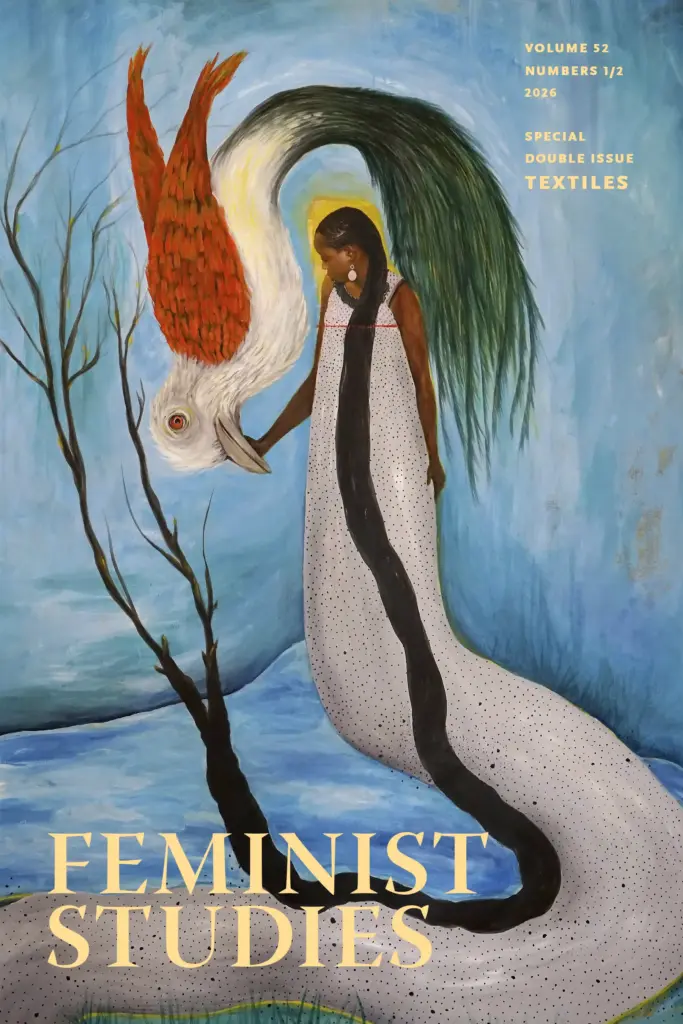
Special Double Issue on Textiles
The editorial collective of [the journal] issued a call for papers for a special issue that focuses on how scholars and artists attentive to gendered relations and power, and feminist theory, are engaging textiles in their research and teaching. We were interested not only in what textiles might help us to understand about established areas of feminist scholarship, but also in how they might help us to explore new questions, methods, and analyses. What types of affects, embodiments, meanings, relations, histories, and assemblages become discernible when we follow how textiles are made, traded, used, and reused? How do textiles contribute to and potentially complicate, our understandings of gender, intersectionality, power, labor, care, intimacy, sovereignty, and other concepts and questions that animate feminist inquiry?
— Attiya Ahmad and Bibiana K. Obler, from the preface
Fernanda Villarroel Lamoza
Taiye Idahor’s Weaving of Lineages with Beads and Hair
Roberto Filippello and Jane Tynan
Redressing the Homeland: Textiles and Feminism in Palestinian Diasporic Art
Amrut Mishra
Warped Feminism: The Relational Archive of Renée Green’s Commemorative Toile
Hannah Schwadron
Dancing in the Dark: Well of Wills’s Judith and the Performance of Virtuous Dissent/Descent
Wafa Ghnaim
The Thobe as a Portrait: Inheritance and Rematriation in the Tatreez Institute’s Dress Collection
Corey Loftus
Casting off Their Womb: Dissonance and Delay in the Work of Casey Jenkins
Reyila Hadeer
Shadow Land: Artist’s Statement
Amber Jamilla Musser
Review of Care at the End of the World: Dreaming of Infrastructure in Crip-of-Color Writing by Jina B. Kim
SaraEllen Strongman
Review of Currencies of Cruelty: Slavery, Freak Shows, and the Performance Archive by Danielle Bainbridge
Kendall Dinniene
Review of Sex Isn’t Real: The Invention of an Incoherent Binary by Beans Velocci
Fernanda Villarroel Lamoza
Taiye Idahor’s Weaving of Lineages with Beads and Hair
This essay focuses on the distinctively feminine forms that Taiye Idahor outlines with threads of beads and hair on paper, shedding light on a relation between the geographic and the genealogical that challenges understandings of the self that delineate the body as a form of property. Far from mere representation of women, I argue, Idahor foregrounds ordinary acts of self-possession through which women, including herself, transform this nothingness as worthless plastic beads or pieces of paper into figurations of the feminine with the power and beauty to claim space in the social field. This in-depth analysis of Idahor’s work is informed by long-term ethnographic fieldwork in Lagos, situating her practice in relation to Edo and Yoruba refined-art-making techniques that, dating as far back as the first millennium, offer a unique approach to portraiture traditions in West Africa. This study is part of a larger feminist project focused on African epistemologies in which I trace the feminine, beyond the representation of women and gender expression, to where it often becomes entangled with otherworldly imagery of birds, fishes, and bodies of water, and occupies a position of vulnerability that invariably turns inward.
Keywords: Ife heads, Benin Bronzes, Lost wax casting, Iyoba, Portraiture, Landscapes, Lineages
Roberto Filippello and Jane Tynan
Redressing the Homeland: Textiles and Feminism in Palestinian Diasporic Art
This article explores how Palestinian mixed-media artists in the diaspora have been employing textiles to renegotiate meanings attached to the female body in the national aesthetic-political imagination. Bringing a decolonial feminism native to Palestine to bear on an analysis of artworks by Laila Shawa and Dana Barqawi, we propose textiles as a route to understanding how women artists creatively engage with themes of gender, labor, and land at the core of the Palestinian struggle. Arguing that textiles can articulate a political relation, we highlight affective modes of seeing and sensing that center Palestinian women’s material-corporeal experience, but also consider the dilemmas involved in building a Palestinian feminist aesthetics outside decolonial frameworks. Working across different genres and espousing a distinct understanding of “resistance” and “feminism,” contemporary diasporic artists use visual motifs and material practices to recode the woman-textile nexus and ultimately propose a vision of Palestinian liberation informed by a more expansive sense of gendered, sexual, and national belonging. Textiles emerge as both a rich material and an analytic in the refiguration of a Palestinian feminist imaginary that unsettles attempts by the Israeli state and the Palestinian Authority to govern women’s bodies.
Keywords: Textiles, Palestine, Feminism, Diasporic art, Laila Shawa, Dana Barqawi
Amrut Mishra
Warped Feminism: The Relational Archive of Renée Green’s Commemorative Toile
This article analyzes contemporary installation artist Renée Green’s archive-based series Commemorative Toile. Through this analysis, I develop two interrelated concepts: “warped feminism” and “woven architecture.” Warped feminism names a method of archival reading based on the materiality of textiles. Contributing to feminist theories of phenomenology and embodied research, warped feminism uses the metaphoric relationality of a tensioned loom as a guide to direct affective experience into attention and inquiry. I develop woven architecture as a theory of identity that uses the structure of fabric as a conceptual scaffold to map difference across imperial, geographic, and historical contexts, while maintaining the particularities of one’s position in relation to another’s through the shifting surface of the fabric. Through these two concepts, I examine the photograph of Commemorative Toile titled This Was Now Then and the upholstered Commemorative Toile furniture housed at the Fabric Workshop and Museum. Ultimately, I argue that warped feminism helps us understand how the Commemorative Toile series constitutes a woven architecture that locates the inextricable links between the deprivation of the barracoon, the ship hold, the salon, and the growing European taste for colonial furnishings.
Keywords: Feminist methods, Archives, Contemporary art, Material culture, Colonialism
Hannah Schwadron
Dancing in the Dark: Well of Wills’s Judith and the Performance of Virtuous Dissent/Descent
This essay engages the dance theater and textile work of the Brooklyn-based collective, Well of Wills in their performance of The Judiths of Virtuous Dissent (2018). Close readings of their live performance and dance film short alongside sonic and woven cloth components explore the prayerful “work of their hands” in a study of ancestral conjuring and embodiment that expresses current-day collective grief and feminist rage. Discussion focuses on the group’s sourcing of the mythological Jewish figure of Judith of Bethulia, known for seducing and beheading her enemy to save her people from annihilation, as ensembles of female-identifying and nonbinary “warriors” become Judith figures themselves. Against musical scores of wailing, bells, shofar, and violins, the cast of Jewish and non-Jewish artists yell, sing, scream, pound, knead, weave, and unravel the imagined rage of their “voice-less matrilineal ancestors” with references to present-day traumas: police brutality, rape of women, mistreatment of immigrants, and economic disenfranchisement, all the while revising a sustained “single story” of Jewish safety through a vision of Jewish justice not just for Jews.
Keywords: Well of Wills, Judith, Jewish, Dissent, Performance, Dance film, Textile
Wafa Ghnaim
The Thobe as a Portrait: Inheritance and Rematriation in the Tatreez Institute’s Dress Collection
This article examines traditional Palestinian dress, or the thobe, as a biographical inscription and material record of a woman’s life and her relationship to the land. Through oral history, material analysis, and dressmaking traditions learned from her mother, Feryal Abbasi-Ghnaim, the author argues that the thobe cannot be stripped from the women who made, wore, and mended it. Drawing from the Tatreez Institute’s dress collection—founded by the author in 2016, with collecting beginning in 2020—the author wrestles with the ethics of acquiring dress objects and distinguishing between colonial harm, capitalist accumulation, and the responsibility of safeguarding heritage amid war, violence, and dispossession. Tracing the inception of the Tatreez Institute, the author shares lessons learned through its first major acquisition and presents the first sixteen dresses in the collection. The article further considers the ethics of collecting Palestinian dress in exile, proposing rematriation as a framework for stewardship that returns cultural objects to Palestinian descendant communities and knowledge systems. Through “Maker Once Known,” the author critiques museum cataloging, provenance, and institutional erasure while proposing new archival approaches that center matrilineal and indigenous histories. The author challenges museum practices that obscure makers and privilege collector biographies, reclaiming a space in the historical record that makes room for the dressmaker’s name as an archival intervention.
Keywords: Palestinian women, Thobe, Material culture, Oral history, Rematriation, Tatreez, Collecting practices
Corey Loftus
Casting off Their Womb: Dissonance and Delay in the Work of Casey Jenkins
In 2013, Australian artist and craftivist Casey Jenkins (she/they) staged a knitting performance that involved knitting from a skein of wool lodged in their vaginal canal day after day, for a total of 28 days, or a textbook-length duration of the menstrual cycle. Jenkins’s work constitutes a physical and conceptual investigation of the womb’s cultural meaning and function beyond reproduction in this solitary, craft-based meditation. By approaching this performance from a crip studies perspective and situating it among separate but connected histories—that of the prevalence of menstrual visibility in the feminist art of the 1970s and that of the technological development of sanitary products and advertisements that form the “FemCare industry”—I argue that Jenkins’s performance queers the menstrual cycle. They separate biological processes from expectations of gender, they exhibit an irregular menstrual cycle that introduces a temporal delay consistent with queer conceptions of time, and they invent a form of menstrual care technology using wool that differs from commercial menstrual care products. At the same time, the knitting terminology used in the performance title “casting off” refers to a symbolic closure designed to block out external opinions and illuminate material limitations that threaten reproductive decisions when access to reproductive healthcare is not protected.
Keywords: Menstrual irregularity, Craftivism, Menstruation, Reproductive justice, Knitting
Reyila Hadeer
Shadow Land: Artist’s Statement
Shadow Land is a photographic work from a larger series that explores my evolving relationship with ethnic-cultural identity as a Uyghur woman living in diaspora. Through visual conversations with objects that have accompanied me across borders, the photographic project examines memory, displacement, belonging, and cultural survival. Central to this work is the doppa, a traditional Uyghur embroidered hat that is both a cultural artifact and a repository of personal and collective memory.
Keywords: Memory, Feminist methodology, Transnational identity, Displacement, Arts-based research, Diaspora Studies