
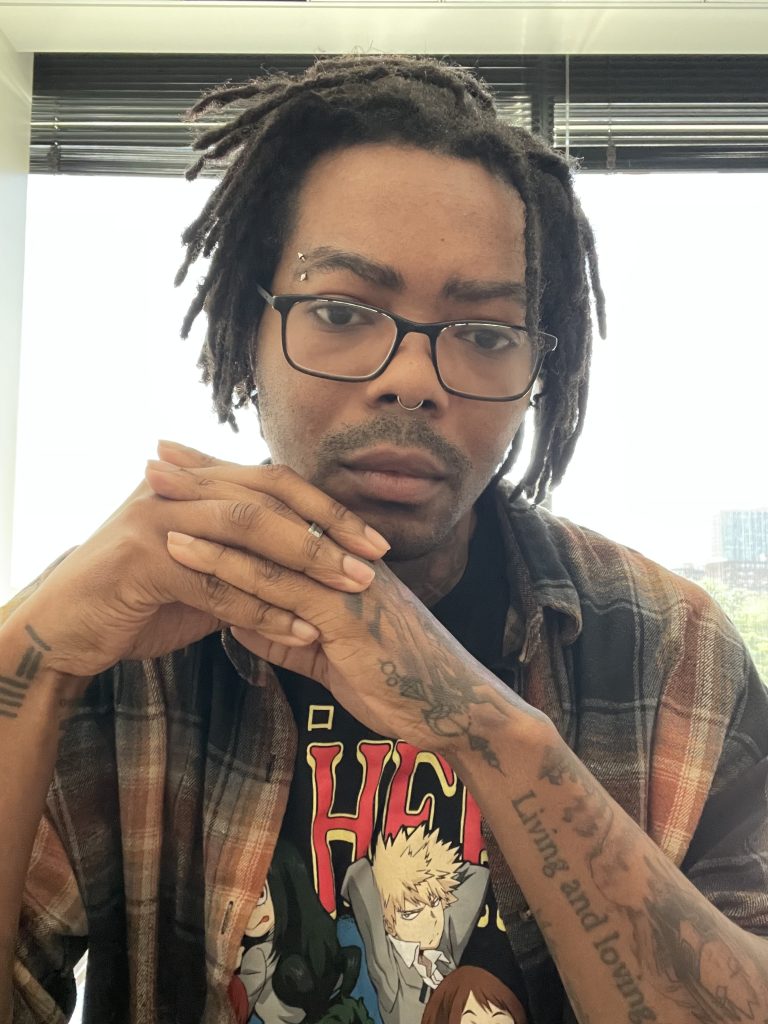
Jennifer (JN): It is my tremendous honor to be in conversation with my colleague and friend, Marquis Bey. Bey is professor of Black Studies and Gender and Sexuality Studies at Northwestern University and the author of many books, most recently of Black Trans Feminism and Cistem Failure: Essays on Blackness and Cisgender, both published on Duke University Press. Their most recent book, which I had the privilege of reading this week, Nonbinary Life: An Autotheory, was published on Bloomsbury in April. Thank you for joining us, Marquis. It’s an honor to talk to you.
Marquis (MB): Thank you for having me. It is going to be such a fun and lovely conversation. Thank you so much for the invitation.
JN: I spent the last couple of days reading this book and thinking alongside you, which was such a pleasure. I wanted to start by asking you about the form of the book, and I wanted to invite you to share some meditations on the term autotheory itself, a category that’s been studied, deconstructed, troubled, problematized, thought of as simply a market category and the like. In particular, I wanted you to talk about why your extended meditation on nonbinariness seemed to require an autotheoretical form.
MB: So I’m going to tackle this in a number of ways. I am incredibly drawn to the genre of autotheory in part because of the people that I read who write autotheory, namely, people like Paul Preciado and Maggie Nelson. Those two are, in a lot of ways, intellectual guides for me when I even think about autotheory. And also, I’ll say, too, that the content of both of their writing also really inspired me as well.
Maggie Nelson’s The Argonauts and then much of Paul Preciado’s work. They’re both writing in ways that really attempt to sit with the destabilization of certain kinds of categories, namely gender, but also other kinds of categories like the human or what have you. That was kind of the template for me, so to speak. I think in addition to that, autotheory serves as a site for me to actually do some deconstructive work, I suppose. If we think about … Etymologically, if we think about autotheory, it seems like it’s self-theorizing.
And I think what I want to do is try to turn that on its head because I don’t understand autotheory as here is this individuated, coherent, cohesive self that I’m then theorizing about or theorizing from. In a lot of ways, what I’m attempting to do is unsettle the grounds of what constitutes the self or even try to think about or interrogate the very notion of the self. And I do that in Nonbinary Life effectively through an assertion of the abolition of gender as one of the pillars of a coherent self. So I think autotheory for me operates as a way to do a certain kind of work of destabilization and deconstruction, which I find to be incredibly generative.
Perhaps one additional thing for me is I want to do the kind of work that I do in ways that … How do I want to put this? I am attempting to write about not myself and what I think or what I’ve experienced. I actually have a pretty strong critique of the discourse surrounding lived experience that we can get into at a later date, but I think what I’m attempting to do is actually use this amalgamation that is called “I” and the encounters that it has had, the reverberation and echoes that it has been privy to, as a way to gain access into the textures and contours of this thing we’re calling, we’re calling life.
So there is a way that I, this I, has encountered things and been privy to things that I think are indexes for larger systems, structures, histories, discourses, et cetera, that I also want to try to, I don’t know whether we want to use mine or excavate or attend to, let’s say, that I think is really, really easy to do for me through the genre of autotheory. And I think lastly, too, autotheory, unlike something like academic theorizing, allows me to use profanity in ways that I really appreciate too. So I think there’s also a little added benefit in that as well.
JN: I love that. The second question that I wanted to ask you is in some ways related to that. One of the things that strikes me about the book, and maybe all of your work, but in particular this book, is that it feels like you forge an intimacy with a reader early on. You start out the book with a love note and the sentence, which immediately jumped out at me, “I don’t quite know what I want this to be.”
In that same opening note, you describe the book as a treatise and a manifesto, and you conclude the opening love letter by saying, “Maybe this is all of those things at the same time. I’ll let you decide.” So in some ways, if I opened by asking you about autotheory and your attachments to it, I wanted to ask you to say a little bit more about the question of genre or how you might answer the question, or refuse to answer the question, maybe, right, what is this book?
MB: So the genre is … Okay, on the one hand, I don’t quite know what genre it is. I think in a lot of ways it exceeds genre. Sometimes it falls squarely into a particular genre. There are aspects that fall into a particular genre. But I think ultimately the thing that I want to say is that I don’t care about genre in the same way that I don’t care about gender, which is not surprising, too, because they share an etymological root. So I don’t care about the genre. But what I also will say is that the writing takes the form of… in a lot of ways, takes the form of what I am kind of, I guess, nervous about.
To try to clarify what I mean by that is, I spend a lot of time, especially in that opening preparatory note and throughout the book, I spend a lot of time really trying to put the reader at ease because I’m anticipating so much bristling, I guess is the word that I would use. I’m anticipating a lot of discomfort, and what I want to do is know that that’s coming or assume that that’s coming and try to hold the reader before we get there because I have a feeling that they will not be someone who is going to be immediately on board with how I’m describing gender or how I seek to depart from gender.
What I want to do on the way there is set them at ease, that things are going to be okay, and to also demonstrate a kind of openness, I suppose. I don’t want to come off too strong, I guess. And I do that via the writing. So the writing is what is dictating the genre or how I feel like I need to write because in that all throughout the book, I felt so much that I had to… It’s not quite walking on eggshells. I didn’t feel like I had to do that, but I really felt like I had to be careful.
Had to be careful. I had to be precise. I had to make sure I was clearing the ground in certain ways. All of those things really made the genre what it… what I felt like it had to be. And that’s … I mean, I don’t know how successful that was, but for me, it was … it’s a question of what I anticipate the reader feeling and thinking, rather than to me a question of a genre that is presupposed that I then write with. It’s just the reader that I am trying to be attentive toward.
JN: So this might build on that question. At some point, and I didn’t write the page down. I can’t remember if it’s actually in the opening note or in the epilogue, you say something like, “If this book is one thing, it’s honest.”
I wanted you to talk a bit more about that word about honesty. I ask that because one of the things that strikes me as so interesting, challenging, strange about writing, perhaps in the genre of autotheory or perhaps in any kind of personal writing, is that readers in the world feel that they know you.
My last book was about my mom, and I would meet people in the world, and they would ask me questions about my family, my mother, my life. And I would have to explain that there was a difference between I and me and that while they had access to a certain composite of me that appeared on the page, there were aspects of my life that were … that I hold personal and intimate and that I don’t want circulating in the world.
I think it’s always interesting because I think books that are personal forge an intimacy with readers that is transformative, I think, and really important, but also I think at times the author is also guarding their own privacy. So I wanted to ask you what honesty means to you in the context of this book and why it felt important in particular for this project’s analytic and political work.
MB: Yeah. Honesty, for me, especially in this book, but even I think more generally, is to be able to say the thing that I think. I do not feel that I can do that in most realms of life. I encounter so much, so many people with whom I can’t say the thing that I wish to say, and that’s … that kind of sucks.
So this book, and I’ll also note that in other aspects of other books that I’ve written or other things that I’ve written, whether that be articles or chapters, I didn’t quite feel that I was able to say fully what I wanted to say because the conditions were such that I was foreclosed from saying things in the way perhaps that I wanted to say them.
But this book, Nonbinary Life, is the most honest book that I could write. Here’s me saying the thing that I think, why I think it is, and not caring nearly as much, and sometime not at all, about the implications that might … that someone might feel that this has. So that’s where the honesty is coming from.
And then to the point as well about knowing or readers knowing me perhaps, there is … I mean, to go back to the point about autotheory as a genre in attempting to deconstruct this self, I think what I’m attempting really to do, who knows if readers get this, but what I’m attempting to do is not give them access to me necessarily, but give them access to the mechanisms that comprise or that make a subject and give them certain kinds of interrogative tools perhaps to deconstruct them, to analyze them, what have you.
So if I am telling them about this encounter, that this thing called I has had, I’m hoping too, that it’ll give them access to the ways that they’ve encountered other kinds of things that might be similar to this. So, how can I give them tools to interrogate their own mechanisms of constitution in ways? And I think I can do that better if I am honest in the way that I’ve described and defined.
JN: I love that. I wanted to ask you to talk a bit more with us about your conceptualization of nonbinariness, or as you say at one point in the book, nonbinariness is “outside of the grammars of identity.” And as you argue, I don’t know if argue is the right word, as you contend, as you articulate in the book, nonbinary is for you not a kind of gender. It is gender’s abolition.
But I wanted to ask you to talk to us about your conceptualization of nonbinary by perhaps thinking with us about the relationship between nonbinariness and a constellation of other terms, some of which are in the book, some of which are in some of your other books, right. So I was thinking in particular of refusal, abolition, and freedom. I particularly wanted to hear to what extent those terms are synonymous for you. Are there tensions or distinctions between them?
MB: Yeah, I think they’re different inflections of one another. Yeah, not quite synonymous, but they reverberate with one another. They inflect at different angles or at different pitches, a similar mood, let’s say. So refusal, freedom, fugitivity, nonbinariness, all these things are attempting to defect from a certain hegemonic imposition that fixes and forecloses and circumscribes that some people will call … that many people will call different things. Some might call it ontology or identity or what have you. All of those are attempts to fix, foreclose, and circumscribe and make static, to make legible and comprehensible.
And to me, things like freedom or refusal or nonbinary are differently inflected ways of being unimpressed with that fixation or of attempting to move away from that fixation in service of another mode of life because those impositions oftentimes attempt to assert that this is what it means to exist, this is what it means to validly be a subject in the world, this is what life is, what have you. And I … all the things that I write about and try to think about are in service of some other mode, some perhaps otherwise mode of life and living that is not possible with the ways that certain identities or ontologies have been imposed upon us.
So nonbinary is perhaps my most current iteration of attempting to do that. Because what I’ll also say is that there might be some folks who aren’t moved by the language of refusal or fugitivity, but might be moved by nonbinariness. So I’m trying to give language to different kinds of entities out there who might gravitate toward different kinds of language in service of this ultimate aim, horizon, perhaps of facilitating otherwise life.
JN: I think it’s really interesting the way you describe this constellation of terms as overlapping, but perhaps having different inflections feels really useful for me. I wanted to ask you to talk about nonbinariness as a way of life. And as I was reading that, I was thinking of Sara Ahmed with feminism as a way of life. And in particular, I wanted to ask you to think with us about what it means to think about questions of politics as about modes of living.
MB: So nonbinary as a way of life allows for nonbinariness, which so often simply gets cordoned off to questions of gender or questions of non-normative gender. It allows for nonbinariness to exceed that confining, which is also interesting, the ways that nonbinariness gets confined, because at least for me, I think about it as this capacitating thing.
So, way of life is useful to me insofar as it allows for nonbinariness to not be confined to the realm of gender, because for me, I’m … I don’t care about gender, as I say quite explicitly in the book. And I go on to explain what I mean by that. But it’s not about gender itself or only or solely. It’s about a whole host of ways that we are confined and imposed and circumscribed and disallowed from exploring or experimenting with various modes of life and living. So the way of life allows for that capaciousness, I think, that disallows nonbinary to be kind of pigeonholed, let’s say.
And then when it comes to the way of life, as the political orientation or thinking about the politicality of these things, I mean, I find that … I find the Sara Ahmed way of thinking about this to be quite apt. And I think also I want to make sure I distinguish this from the feminist dictum that the personal is political. That, for me, that’s not quite enough. That’s not quite it. It’s not that the personal is political in this way. That is kind of like my self-care is me doing politics. All right, cool, but okay. It’s not quite enough for me.
For me, I think about politicality as this way of how am I not only thinking about myself and what I do to take care of myself, but how am I living and moving and relating in such a way that allows for other things to be lived or other modes to be lived? How can I, for example, in the way that I move through the world, allow for others to move through the world more expansively and capaciously? Am I someone who meets someone and forecloses what they might be by calling them sir or ma’am, or shaking their hand in this way if they’re this kind of gendered subject, or giving them a hug if they’re this gendered subject?
All of those to me are ways of disallowing the entity in front of you to be something other than what we might assume they might be. So that’s how I’m thinking about way of life. It’s how I organize what it means to live in the world that then permits so much more than what is permitted by normative language or behavior or relationality. And to me, that is a very expansive politicality because what it’s doing is doing the work of allowing for other modes of life.
It’s allowing for various entities, people, subjects, whatever we want to call them, to recognize or believe or experience for the first time perhaps that some other form of me or this is possible, that I don’t have to be this kind of subject. I can be or think something else. And that to me is a kind of politicality. If it’s not … If to me, politicality is precisely the permission of doing or being something else that has been other than what has been imposed upon us, a way of exceeding the grammars of law or of normative being, let’s say. I want to offer that as way of life.
JN: So what you said leads perfectly to my last question, which is one of the things I really admire about your writing, and the way that you move through the world is that I think of you as a deeply utopian person in a moment where Black studies is often plagued by forms of thought that are anti-utopian, to say the least. And so I’m thinking about in Nonbinary Life, your beautiful short rumination on the redwoods as a kind of … as a quintessentially Marquis … Marquis-ian moment of utopian, right. And you talk about the forest as a place where you feel, “Unconditionally invited.”
I wanted to close by asking you to talk about the importance of utopianism, or sometimes you use the word otherwise. So utopianism or otherwiseness, the idea of the beyond to your thinking and writing, particularly in fields like Black studies, where utopianism has, in some ways, is seen as naive. To be kind, seen as naive. And so I’m wondering … And then in the political moment that we inhabit, where it feels like utopianism feels like a kind of impossibility. I wanted to hear you reflect a bit more on the importance of utopianism both to your writing in Nonbinary Life, but also to your kind of politics.
MB: Yeah, I am constantly the resident optimist in all the spaces that I find myself in, and I’m perfectly okay with that. Actually, I remember one of my students was in a class with someone … with some folks, and they had read some of my work, and then someone, quote, unquote, accused me of being utopian. And then my student said, Marquis would say, thank you. And I’m like, “That is absolutely the case.”
Because for me, utopianism, the otherwise, idealism, whatever we might want to call it, whatever word we want to give to it is a … it gives me a sense of why are we doing this. If I … I mean, I genuinely want to know why are we doing this if we do not think that something could be different. And if we are not aiming for something else, if we are not aiming for the highest or if we don’t want to hierarchize this kind of verticality, for the most expansive kind of life that we can imagine, if we’re not aiming for that, what the hell are we doing then?
But for me, utopianism is this very, I think, quite sober attachment to or yearning, desire for this mode of living or this possibility for relationality that is precisely what I want. I’m calling that utopian, and it is very much a world that is free of violence, and those kind of capitalistic or supremacist or hegemonic ways of relating, that is quite utopian and I don’t understand what we’re doing if we’re not aiming for that. That is my politics, I suppose.
All the ways that we are trying to fight various oppressive systems, if we are attempting to dismantle and get rid of all of those things, that then is a utopian project. Is that not what we’re doing? And I think I absolutely hear you in the kindness that you’re giving to some strains in Black studies that, in a lot of ways, promote a kind of nihilism or pessimism. We’re not going to name any names. We could name many names, though. And then that deemed utopianism or otherwise a kind of pipe dream or a project of futility.
I think, to say the least, I depart from many of those things. Surely, I think there are aspects of a discourse like Afropessimism or what have you that could serve useful in certain ways. Sure. But I am very much unapologetically and politically oriented toward the utopian, the aspirational, the ideal, I guess, because that is why we’re doing this work. That is why we have this long, long history of doing this work. It was a … I mean, to me, it was a utopian project to believe that the institution of slavery could end. That was such a … Who in their right mind would think that, “Yeah, this whole system right here, that is no longer going to be a thing.” And yet it is a project that was believed in. So I come from a utopian politics that I call the Black radical tradition that I call Black feminism, and I’m going to continue to commit to that. So it is deep in my politics because I don’t know what I would be doing if I weren’t trying to do the most I could for the kind of liberatory project that I’m interested in.
JN: It’s funny, as you were talking, I was thinking of my colleague Kathi Weeks’ work, and there’s a lovely moment in The Problem With Work where she’s talking about how anti-work feminist politics often get dismissed as utopian. And I actually pulled it up because I was like, “Oh, this so resonates with what you’re saying.”
She says, “What if the utopianism of these demands is not a liability but an asset? What if we were to respond to the charge of utopianism not with embarrassment or defensive denial, but with recognition and affirmation, and what might such a utopianism without apology look like?” Which I think is a really lovely turn of phrase.
Thank you for talking to us. Your book is fabulous. It was really exciting to get to think with you and also to see you trying out a form that both feels like it intersects with some of the work that you were doing before, but also feels like you’ve trying out a different kind of voice. So it was exciting to see that. And I look forward to seeing how the book travels. So thank you, Marquis.
MB: All right. Thank you. This was just a lovely conversation. It’s always just a delight to talk to you and to think with you. So thank you for offering this space as well.