| |
|
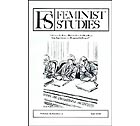
Nineteen eighty-two has seen the massive growth of an American anti-nuclear war movement with a strong and diverse feminist component. Although the scope of this movement is unprecedented, women's mobilization against war is not: the intertwined growth of feminism and pacifism in the decade preceding World War I is a well-appreciated part of our heritage. Less well known are the creative and dramatic efforts of Women Strike for Peace, an organization born late in the McCarthy period, at a time when most progressive movements, including feminism, were at a low ebb. Amy Swerdlow's insightful reconstruction of this movement's history opens this issue of Feminist Studies. Exploring and recovering the dissident voices of the 1950s and early 1960s is an exciting and crucial task, and we look forward to future contributions on this era in our pages.
Another central political development of the 1980s is the renewed commitment to understanding and combating racism in the women's movement. Antiracism seems particularly urgent now, as the social policies and cutbacks of the present U.S. government pit women and minorities against one another. Among the 50 percent of minority Americans who are female, feminist activism is flourishing, and healthy criticisms of/and connections to the mainstream women's movement are growing. In a provocative contribution to continued consciousness raising around racism and feminism, we welcome Leila Ahmed's discussion of Middle Eastern women and of the ignorance-verging-onracism with which Western feminists often approach them. We are also very happy to publish June Jordan's poem, "From Sea to Shining Sea", which is a powerful example of contemporary black feminist writing. Also in this issue are three responses to Annette Kolodny's "Dancing Through the Minefield: Some Observations on the Theory, Practice, and Politics of a Feminist Literary Criticism" (vol. 6, no. 1), and Kolodny's rejoinder. These pieces explore basic divisions of race, class, and homophobia as they affect feminist theory and practice. Feminist Studies will be publishing articles on black and white feminism in vol. 9, no. 1, our next issue. We are eager to continue to solicit work on these central questions.
{READ MORE AS PDF}
|
| |
|
Amy Swerdlow
Ladies' Day at the Capitol:
Women Strike for Peace Versus HUAC
Leila Ahmed
Western Ethnocentrism and Perceptions of the Harem
June Jordan
From Sea to Shining Sea
Judith R. Walkowitz
Jack the Ripper and the Myth of Male Violence
Ellen Ross
"Fierce Questions and Taunts":
Married Life in Working-Class London, 1870-1914
Martha Vicinus
"One Life To Stand Beside Me":
Emotional Conflicts in First-Generation
College Women in England
Judith Kegan Gardiner, Elly Bulkin, Rena Grasso Patterson, Annette Kolodny
An Interchange on Feminist Criticism:
on "Dancing through the Minefield"
|
-Corner.gif)